

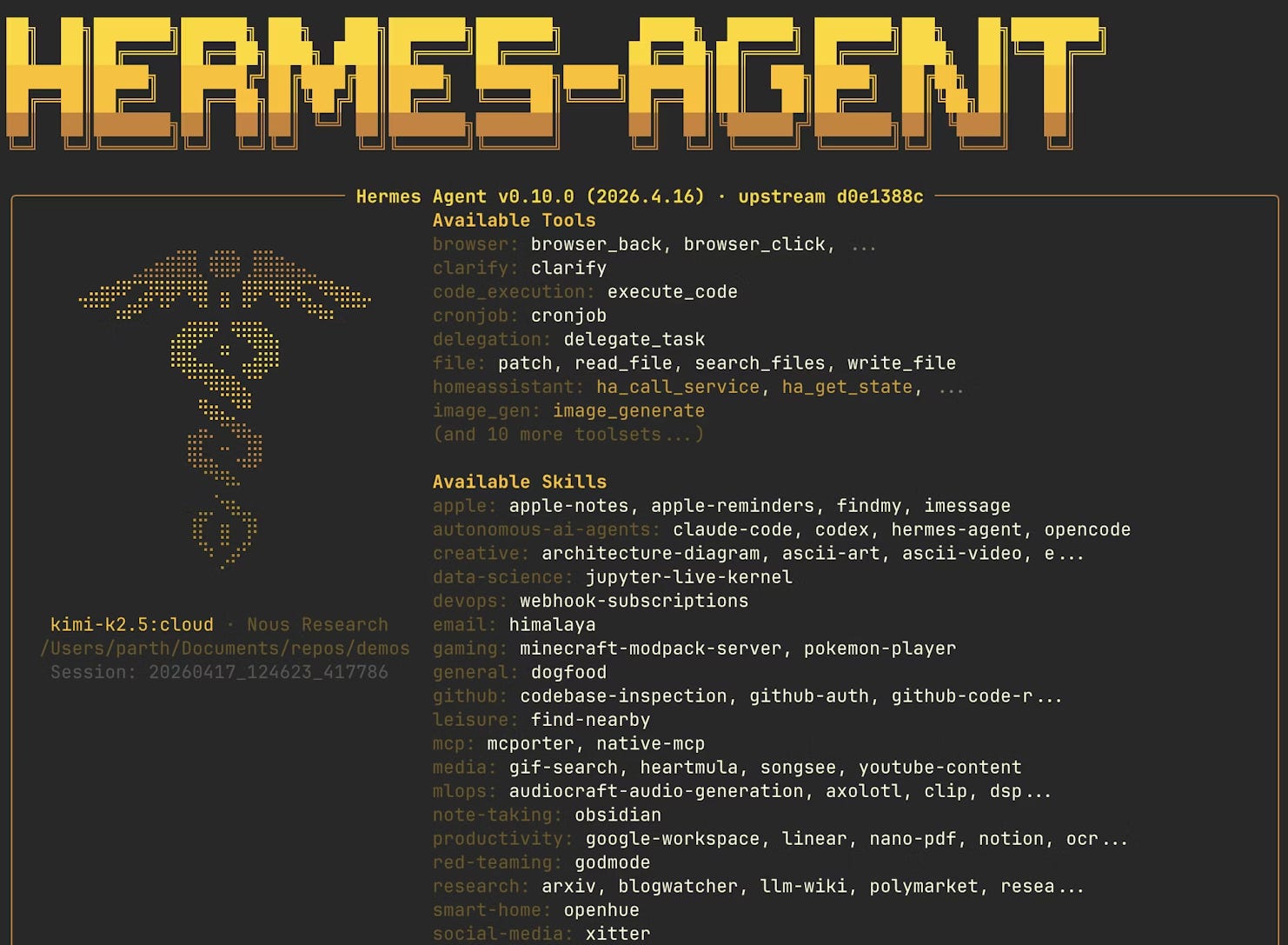
Open-source projects like OpenClaw and Hermes Agent have pioneered a new generation of AI assistants: more autonomous, more proactive, and better suited for automations that save businesses time.
After a few months using them, it’s time to take stock of where they stand and help you decide if they could work for you.
Autonomous employees
There is a large gap between what software companies announce and what the actual product experience feels like. Every large tech company claims to offer autonomous agents. But Hermes Agent and OpenClaw are vastly more autonomous than other agents.
Let’s review the main players.
Google Gemini and Microsoft Copilot feel like workflow automation platforms, each a user-friendly, AI-powered take on Zapier. They work best when the workflow that you want to automate is largely deterministic. The top use cases include:
Summarizing your email inbox.
Meeting preparation (summarizing all the docs related to a person or company).
Notifying you when something happens in one of your connected apps.
Drafting emails, social media posts, and newsletters as part of a repetitive workflow.
Their main limitation is that their bar for “good enough” is probably lower than yours if you are a knowledge worker. Google and Microsoft actively throttle the number of reasoning steps and tool calls to make money from a $20/month subscription.
Anthropic’s Claude and OpenAI’s Codex are powerful personal productivity apps. They make you work faster when you are at your desk. When used with high or very high reasoning effort (which should be your default), they don’t stop until their output is pretty good. They can do that because they are heavily subsidized, especially their personal plans, meaning that you easily get $2000 of tokens on a $200 / month plan. They create and run code whenever they can, which makes them pretty good at:
Software development, of course.
Legal contract review and editing.
Review of financial and accounting statements.
Data analysis and creation of dashboards from multiple sources.
They are comfortable with ambiguous, non-deterministic instructions, and generally have good common sense when making decisions. They are tied to an employee and usually inherit their permissions from that employee, which means they are not very useful when the employee is not at their desk.
Finally, OpenClaw and Hermes Agent are open-source projects, each built by the community under the leadership of a well-respected leader, that embody the next generation of what AI assistants should look like.
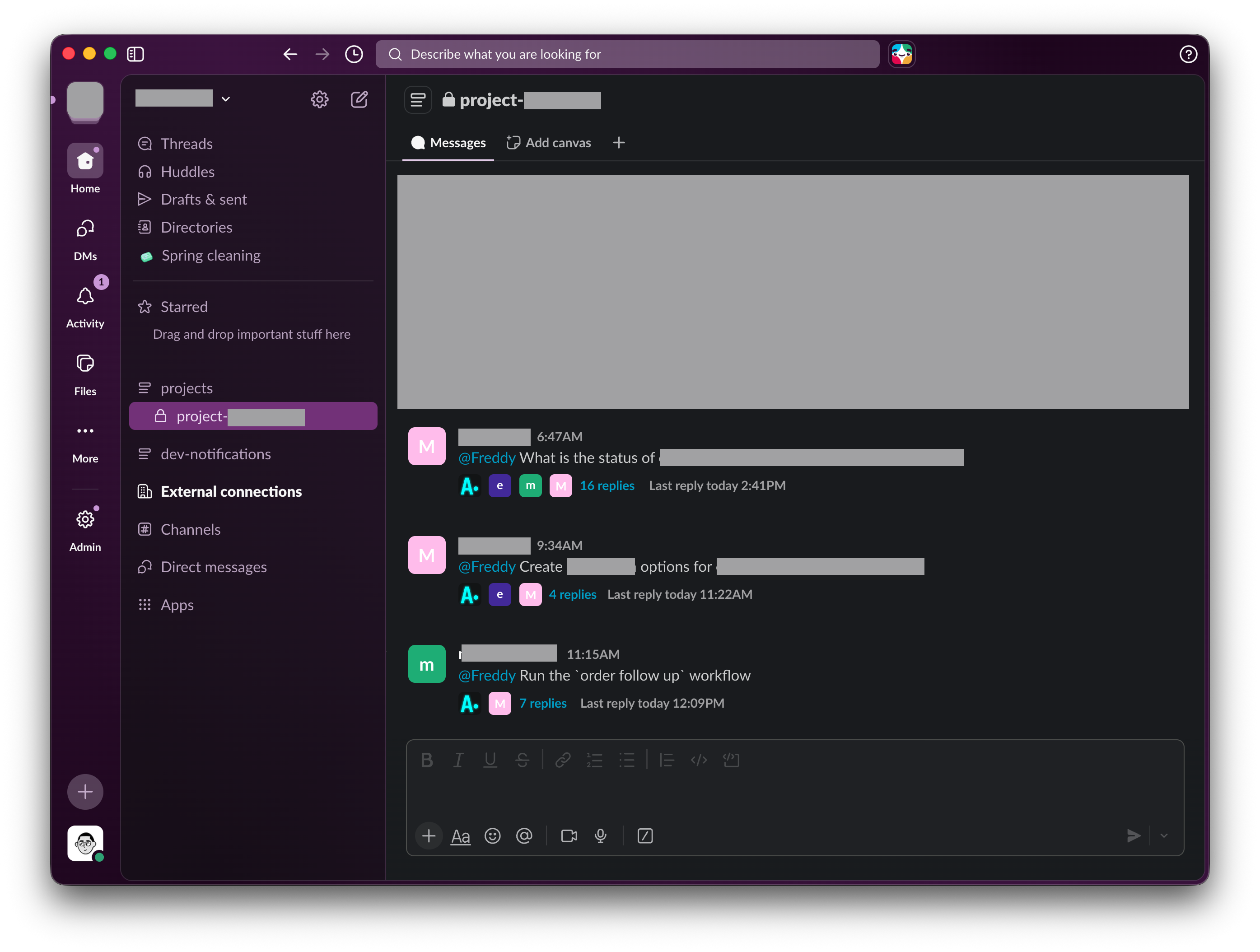
They are always on, always planning for new ways to achieve the goals given to them with the tools at their disposal. They can (and should) be hosted in the cloud, use their own email and other accounts, and be set up to take instructions from multiple company employees via Slack channels so they don’t get stuck when their owner is not at their desk.
In short, they behave like autonomous employees rather than productivity tools. They can do anything that the other assistants can do, but are also good for:
Personal assistant work: booking and rescheduling meetings, researching travel itineraries.
Project management/coordination between multiple team members.
Activities that require jumping often move from one workflow to another, as a regular employee would. They are particularly helpful as junior sales assistants.
Managing internal approvals, based on non-deterministic decision rules.
Understanding the risks and limitations
Due to news reports of agents deleting files and leaking credentials, the public perceives autonomous agents as unsafe.
While it’s true that they are not ready for the general public, their proper use in a professional environment depends on whether the person setting them up knows what they are doing, just as when you configure an email provider or a cloud server.
Because creating an autonomous agent is time-consuming and risky, you and your company will only get it done if the benefits outweigh the costs. The IT and Legal departments will object, and can only be convinced by the business. So, make sure that you focus on use cases that save your company real money.
Here are the most important security principles:
Each Hermes agent should be allowed to speak only to selected employees. It should have a strict allow-list of coworkers. Keep in mind that it can’t be expected to keep secrets from any member of this subset of people.
The implication of the previous point is that you should have many Hermes agents, each living in its own Slack channel and focused on its own tasks.
If the agent talks to more than one person, it should have its own email address and other accounts to avoid confusion about who took each action. It should have its own file workspace (e.g., a shared Google Drive, Dropbox folder, or Google Cloud storage bucket) and only create/edit files in that workspace, with file history enabled.
Skills and integrations should be added gradually to support the tasks delegated to the agent. Keep the capabilities as narrow as possible to match the job to be done.
All configuration settings should be version-controlled (usually in code repositories).
Autonomous agents consume a lot of tokens. If they use Opus 4.7 (the most expensive LLM), they can easily spend several hundred U.S. dollars per day. Use cheaper models such as Google’s models, Kimi, GLM, and Qwen for most tasks, and only use frontier models from OpenAI and Anthropic when necessary.
Whatever the model, check the LLM provider's data retention policy to ensure your data is not used for training.
Getting started with Hermes Agent
Hermes Agent is best installed on a Linux server in the cloud. Hetzner’s European facilities offer great value for money (less than $20 / month for a powerful Ubuntu server with 4 CPUs).
To install Hermes (or OpenClaw), you must enter commands into the Terminal. The official web pages say it can be done in a single command, but to do it well, it’s probably closer to 30 pages of instructions.
Start with a checklist (here is the link to mine) and make the effort of understanding what each command does. Do not delegate blindly to someone else. The good news is, an AI assistant can guide you through the process step by step. Don’t panic if something has changed and the instructions no longer work. Ask the AI assistant for help.
The agent’s workspace (execution environment) should be different from the folder where the agent lives. Hermes offers two convenient options for this: Docker container (on the same server) or Daytona (on separate servers). Most people use Docker containers.
Credentials management requires careful consideration for each use case. Various solutions exist that place proxy servers between the agent and external APIs, adding credentials without the agent seeing them. They are appropriate in some situations, but in others, they simply confuse you into thinking that the problem is solved when, in fact, it has relocated to some other part of the stack. Short-lived access tokens delivered by a credentials storage server, combined with a “hook” that blocks messages containing credentials, is sometimes the best and simplest approach.
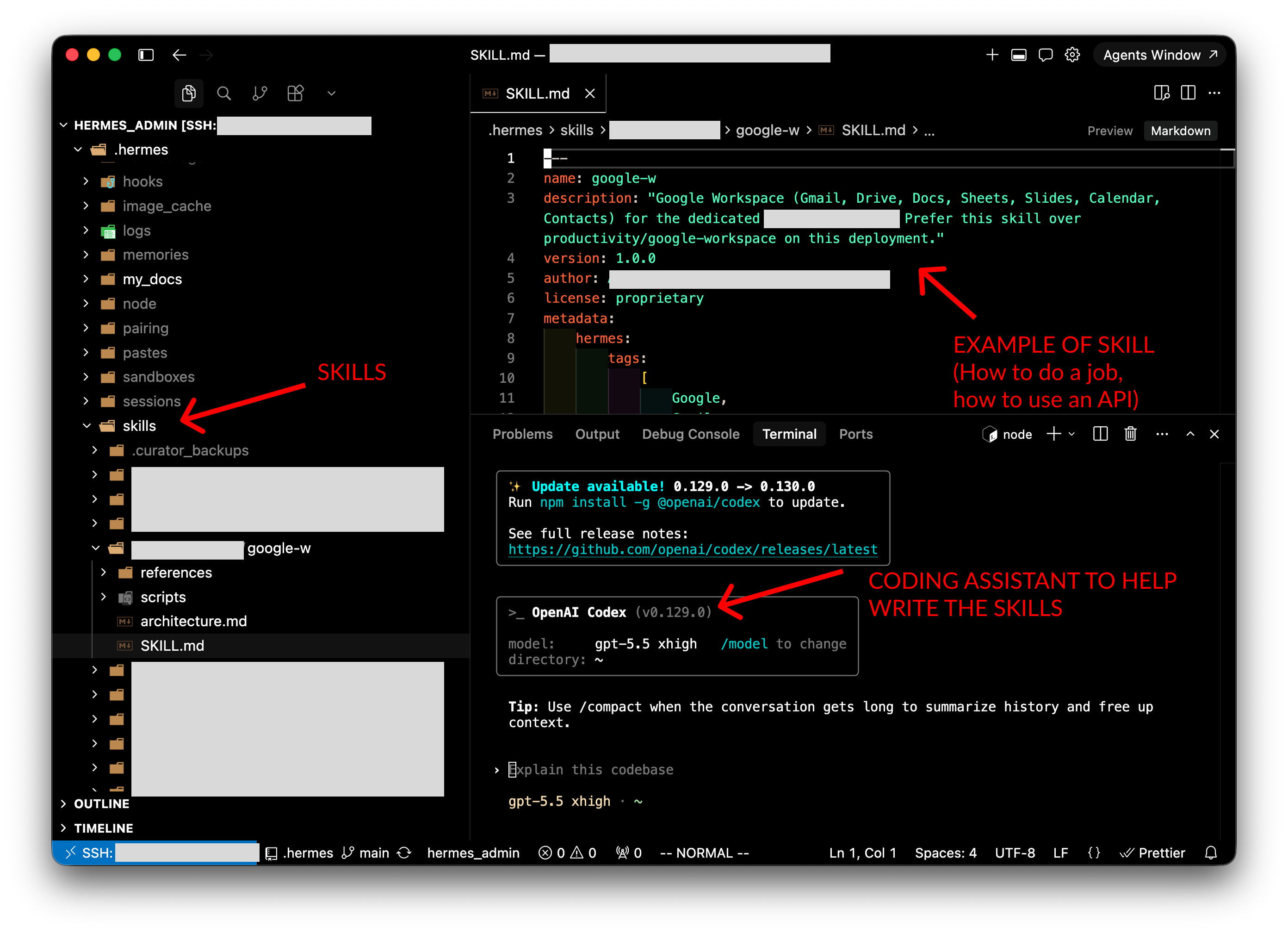
Install a coding assistant, such as OpenAI Codex, on the same server as the agent so the assistant can read the agent’s code, explain how it works, and help troubleshoot it. My installation checklist includes several coding assistants.
Agent Skills
Launching the agent is just the beginning. The real value of an agent lies in its “skills,” which are file folders containing instructions on how it should perform its job.
Each skill contains instructions in plain language and small code scripts (usually in Python or JavaScript). Skills can be business workflows or technical instructions for accessing a data source (e.g., how to query a specific database).
Whoever is in charge of the agent should spend tens of hours writing and refining these skills with the help of a coding assistant. Hermes can write its own skills to codify what it learns over time, but human curation is essential to avoid chaos. Review and revise the skills weekly.
Conclusion: Should you try Hermes Agent?
Hermes Agent is great if:
You want to make an agent the owner of a workflow. This is different from just making an existing employee work faster, which Claude and Codex can already do well.
You want multiple team members to interact with the agent. The typical scenario is to have the agent live in a Slack channel that multiple employees access from their laptops or mobile devices.
You have access to someone who is technical enough to fiddle with Linux servers.
OpenClaw is similar to Hermes and is a few months more mature. Some users find OpenClaw too bloated these days, but it continues to be optimized daily and remains a strong option.
Here is the official link to Hermes: https://hermes-agent.nousresearch.com/