


69% of executives believe AI agents will reshape their business this year. The agentic AI market will be worth $60B / year by 2031. You already know this and have several AI initiatives at your company.
What should you do, and in what order? More importantly, what should you personally focus on as a leader?
Your fellow CEOs are posting about their weekend vibe-coding prowess on LinkedIn. Leading from the front is great for signaling that AI matters, but it won’t move a 2,000-person organization. Resist the urge to feel like a young solo builder again until you have fixed how your company operates. It’s about delivering an agentic operating model.
Think about where corporate inefficiency lives. It’s not in any single person’s work. It’s in the handovers, the duplicated efforts, the back-and-forths between teams. Getting everyone a chatbot subscription barely scratches the surface. The companies pulling ahead are the ones where employees work more autonomously — using AI to handle tasks that previously required delegating to, or waiting on, someone else. That’s how AI-native startups achieve $1.5M to $6M in revenue per employee, compared to $500K at Fortune 500 companies.
The next step is to fix how work flows through the organization.
Here’s what your CEO roadmap could look like.
Communicate the ambition and urgency
Your employees must act like builders.
The message should be clear: the company is becoming AI-native. That means delivering more value to customers with fewer handovers, flattening hierarchy, and giving individual contributors the tools to do work that previously required a team. Every employee’s job will get more interesting by delegating tedious tasks to agents. Change is urgent: every week, we must see progress.
Two KPIs matter most: % weekly adoption as an input metric, and revenue per employee and speed to market (however your industry measures it) as output metrics. These are the numbers that reflect structural change, not just “initiative X is live”.
78% of C-Suite executives say that getting real value from agentic AI requires a new operating model. If that’s where your industry is headed, the CEO needs to be the one who says it first.
Follow the announcement with early symbolic actions that make AI experimentation easy and visible:
Basic AI subscriptions for everyone: Google Gemini or Microsoft Copilot.
Premium subscriptions for anyone who wants them: OpenAI, Anthropic, or Perplexity. Don’t make people justify the upgrade with a business case.
Specialized tools for specialized teams: design, marketing, and engineering.
Showcases and knowledge-sharing sessions — in dedicated Slack/Teams channels and at a fortnightly all-hands 45 min panel discussions.
A hackathon: give people a day to go wild with agents in a sandbox. They can get their hands dirty without risking the business.
These moves are cheap relative to their signaling power. They also flush out your power users (the 20% who will become the engine of your transformation). Today, only 28% of employees know how to use their company’s AI tools. That number needs to move fast.
Build a dedicated AI team
The AI landscape moves so fast that keeping track of what’s possible, let alone what’s practical, is nearly a full-time job. You need a dedicated AI task force, led by the CEO. An operational team with real authority to prioritize, build, and ship.
MIT Sloan Review nails the problem: in most organizations, technology executives focus on infrastructure, and strategic executives focus on markets. Agentic AI doesn’t fit neatly into either box. Only the CEO can bridge that gap.
Team members can retain their departmental reporting lines while dedicating at least 50% of their time to the task force. Think of them as SWAT teams — they parachute into departments, help identify the best use cases, set up the tools, and get projects off the ground.
What kind of people do you need? Not AI researchers. You need people who are good at applying AI, which is a very different skill set:
At least 50% dedicated.
Tech-savvy enough to read and write Python code and have a working knowledge of APIs, OAuth, and cloud environments. You can’t automate enterprise workflows without understanding how systems talk to each other.
Deep enough in the business to spot the high-value workflows.
Resourceful and don’t take no for an answer.
Strong writers — because communicating clearly with AI is the #1 skill that separates power users from everyone else.
Prioritize and document use cases
Your next deliverable is a list of priority initiatives.
42% of companies abandoned most of their AI initiatives in 2025 — up from 17% the year before — largely because they spread themselves too thin.
Pick workflows that meet three criteria:
Labor-intensive: They eat up significant employee hours.
Frequent: They happen several times a week.
Documentable: You can write a memo to teach an intern.
A $200M/year company can realistically pursue 3 meaningful use cases per quarter. Three done right will generate more value than fifteen done just because every department must show progress.
Prioritization must be decided top-down. Don’t crowdsource ideas through employee surveys. As Bain Capital Ventures found after studying a year of enterprise AI deployments, top-down direction and AI literacy matter far more than having the right tools.
Immediately after prioritization, you must assign team members to document the current process and the ideal end state. Workflow mapping is the most time-consuming part of agentic transformation, so don’t wait to get started.
Deloitte’s Tech Trends 2026 shows that many agentic AI implementations fail not because the technology doesn’t work, but because companies try to automate their existing processes as-is. As a CEO, you must be clear in your expectation that priority workflows will need to be reimagined.
Choose your agentic stack
Now we are getting to the tooling question. The market is crowded and moving fast.
You have to decide between N8N, Google Gemini Studio, Microsoft Power Apps, sidebar agents from SaaS vendors (Notion, Salesforce, Netsuite, ServiceNow), Claude Cowork, Microsoft Cowork, Perplexity Computer, Manus, OpenClaw, Genspark, OpenAI Frontier, and more arriving every month.
First, you need to decide whether to stick with the AI offerings from your existing vendors (e.g., Microsoft, Salesforce, Google) or open up to AI-native agents (e.g., OpenAI, Anthropic, Perplexity). Gartner projects that by the end of 2026, 40% of enterprise apps will embed task-specific AI agents.
To be honest, this decision trips up more companies than it should. The AI offerings of traditional software vendors are not sufficiently useful today. Perhaps they’ll be in 12 months. If you want to move now, you need to build on AI-native agents on top of your systems and databases.
Four questions will help you narrow the field:
What user experience do you need?
Chat: Quick, low-cost, conversational. A user asks questions and gets answers. Think Google Gemini Flash.
Flow: Deterministic automation that runs with minimal human intervention. Think invoice processing or data reconciliation. Think N8N.
Session: A human orchestrating multiple agents through interactive conversations. This is where knowledge work lives — strategy, analysis, content creation, anything requiring judgment and taste. Session-based agents like Claude Cowork are actually coding agents with a nicer interface.
How much customization do you want?
In general, the biggest problem that you’ll encounter with any automation platform is when its functionalities support almost everything that you need (say 80%), but not quite. The remaining 20% is a huge headache, requiring endless workarounds. Assume that you’ll need more customization than you think.
Where does the data live?
Claude Cowork runs on each employee’s desktop. Perplexity Computer runs entirely in Perplexity’s cloud. Some workflows involve sensitive data that must stay on your infrastructure; others don’t. Sorting this out early prevents painful migrations later.
What’s the budget?
Is this $20/employee/month or $200? Is $1 acceptable for each customer interaction, or should it be $0.05? The economics vary dramatically across platforms and use cases.
Answering these questions will narrow down the list of options.
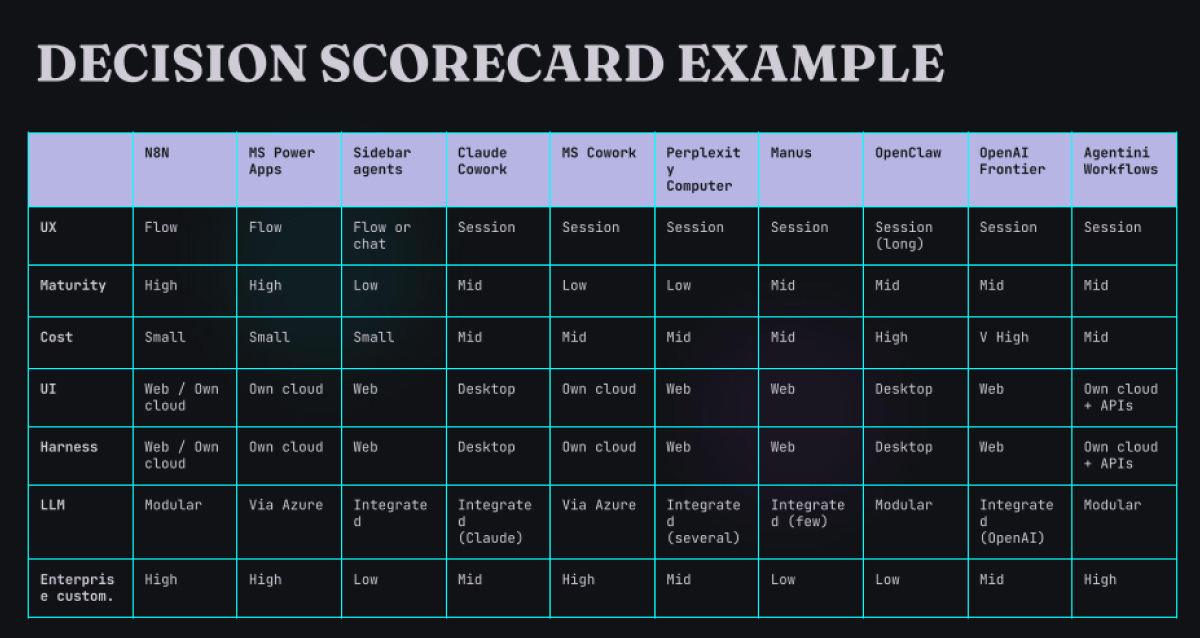
For many types of knowledge work, Claude Cowork is a great and versatile solution for the time being.
But, whatever you choose, design for portability. You don’t want to be locked in. By packaging your company’s automations as skills — reusable text-based instructions that tell an agent how to perform a specific task — you can easily move them from one platform to another. Think of skills as standard operating procedures written for your AI workforce, far easier to maintain than the proprietary visual flows of Microsoft Power Automate or N8N.
Make sure your SaaS apps play nice
To be clear: I’m not suggesting you rip out your CRM, ERP, or HRIS. These systems of record are brutally hard to build, despite claims to the contrary on social media, and migrating off them will drain your team’s energy. Even OpenAI and Anthropic are using Slack, Salesforce, and NetSuite, after all.
But your existing SaaS apps need to be AI-friendly. What does that mean in practice?
They have extensive, stable, and well-documented APIs.
They support a healthy ecosystem of third-party integrations.
They don’t make you wait weeks for API key approvals or new integration permissions.
Your vendors will become obstacles to AI adoption if they have impenetrable documentation, restrictive API policies, and glacial approval processes.
If your AI agents can’t read from and write to a system, that system is a bottleneck, and shutting it down becomes a priority.
Connect the pipes
Credentials, permissions, APIs, CLIs, OAuth, and MCP servers… They enable AI agents to access your company’s data.
Agents need permissions, which fall into 2 main patterns:
Personal agents inherit the user’s existing permissions. If a sales rep can see their accounts in the CRM, their agent can too.
Workflow agents receive dedicated API keys scoped to the exact data they need to complete a particular task. Think of a lead generation workflow. Nothing more, nothing less.
Your IT department will push back. New app installations must be approved. New API keys mean new attack surfaces. New service accounts mean new security risks. These concerns are legitimate. Yet, at some point, they will need to be over-ridden. Integration requests for agentic projects must be endorsed at the top. Only the CEO can change the organization's risk posture.
Launch before you’re ready
If you wait until governance, measurement, and scale-up plans are fully baked, you’ll always be a step behind. Most AI use cases will be significantly reworked after launch anyway, based on user feedback, evolving technology, or just the reality of how the workflow actually plays out in production.
Start with basic logging. Use AI coding assistants to spin up a quick dashboard and see what your agents are doing.
It takes a while to figure out the right governance and the right observability and evaluation frameworks for your company’s use cases: probably at least a year of trial and error. You can start working on them early, but don’t make them a prerequisite.
Avoid the usual traps
The same mistakes keep showing up:
Prioritizing by opinion, not data. Someone on the exec team gets excited about a use case, and it jumps to the top of the list without any analysis of how much time or money it would actually save. 56% of CEOs report no significant financial benefit from AI despite doubling their investment. In most cases, they invested in the wrong things.
Staying in experimentation mode too long. McKinsey reports that nearly two-thirds of organizations haven’t begun scaling AI. So, if you are still running pilots, you are not the only one. But it’s time to focus on adoption: what are the use cases that are going to be used by 50% of your employees or your customers?
Hoarding the good tools. Your company is already paying for Google Workspace or Microsoft 365, so authorizing another $200/month for Claude or Perplexity feels redundant. It’s not. The bundled AI features in your existing stack are a starting point. Power users need power tools.
Governing before you’ve proven value. Risk management and compliance frameworks are essential, but they should follow value. If you over-invest in governance before confirming that a use case actually works and matters, you’ll have a beautifully documented process for something nobody uses.
Wrap-up
95% of enterprise AI projects fail. That’s fine. Fail fast, then double down on the 5% that could become 90% of your product or your business.
Meanwhile, stay focused on your priorities as a leader:
Communicate the ambition
Build a dedicated AI team
Prioritize and document use cases
Choose your agentic stack
Make sure your SaaS apps play nice
Connect the pipes
Launch before you’re ready
Above all, you must instill a sense of urgency.