

Since ChatGPT launched in November 2022, educating employees on AI has been a top priority for Chief AI Officers.
Almost every company has rolled out Microsoft Copilot or Google Gemini to its staff. They have linked these AI assistants to employee email accounts, meeting tools, and document workspaces. Software engineers use AI tools daily for research, architecture design, and code generation.
Employees have become more productive thanks to these new apps, but it’s hard to tie the impact to tangible cost savings because saving 30 minutes here and there doesn’t usually move the needle.
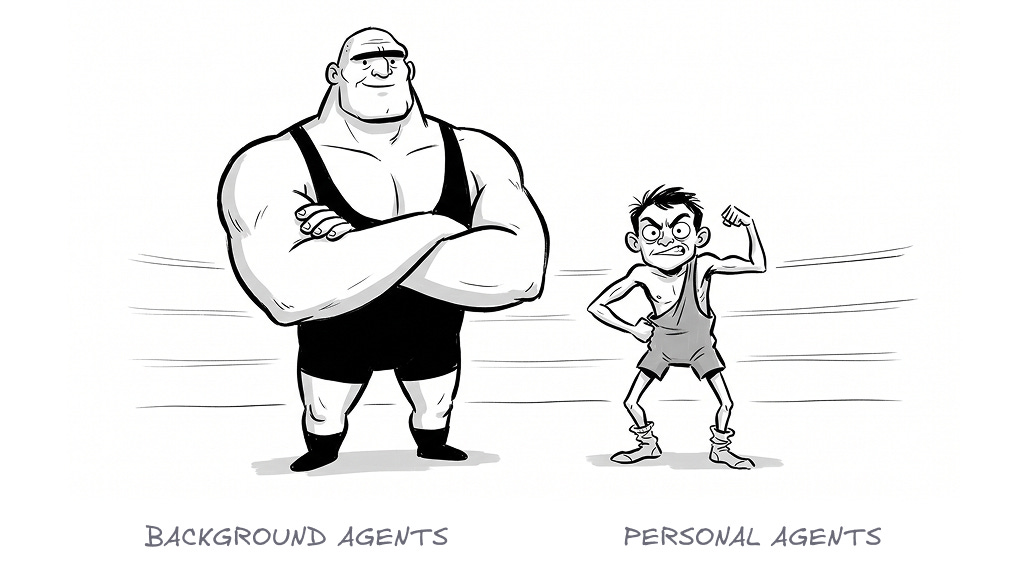
Software vendors are aware of this challenge and have rebranded their AI chatbots as “agents” to position them as low-cost employees rather than extra tools. Sadly, the big agent rebranding doesn’t change the fact that Microsoft Copilot’s “agents”—the most prevalent enterprise agents out there—are for the most part narrow personal automation tools, similar to Microsoft Power Automate before them.
Prioritize agentic workflows
For Chief AI Officers, as 2027 approaches, it is time to shift focus from personal productivity to team-wide productivity.
Practically speaking, this means the Chief AI Officer should lead the creation of agentic applications that enable teams to delegate substantial portions of work to autonomous AIs.
Agentic applications are not cheap to run: the inference cost of an end-to-end task can range from $5 to $20, even when using open-weight models. Therefore, agentic applications must eliminate or parallelize process steps that would take a human 1-2 hours to complete and that are repeated 20+ times per week, allowing one or more full-time employees to be reallocated to other roles.
The Chief AI Officer’s involvement in driving the adoption of personal productivity tools can shift from operational leadership to governance. Business units can manage personal productivity initiatives, often using specialized AI-powered software (e.g., for marketing lead generation, CRM, or coding assistants). The IT department can handle AI training, education, and tool administration.
Anatomy of an agentic application
An agentic application is an enterprise application that runs 24/7 to execute repeatable workflows autonomously.
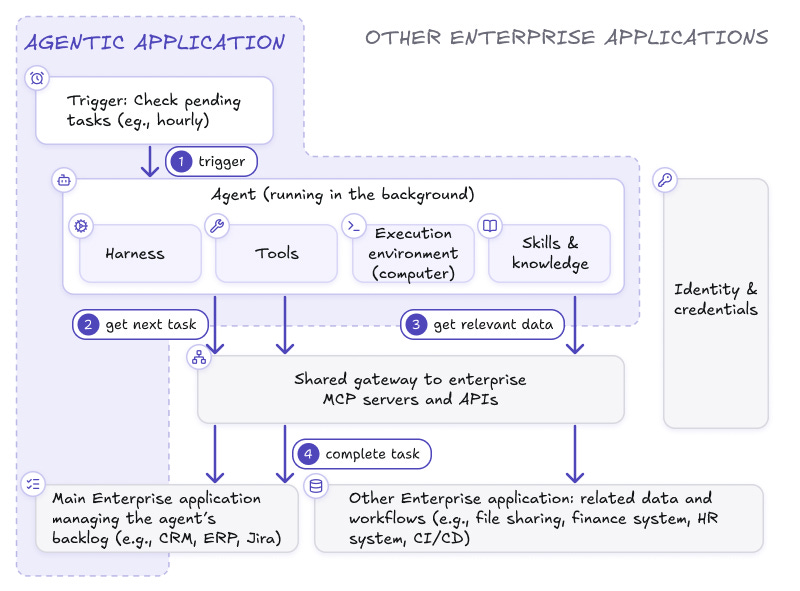
In an agentic application, the agent does not wait to be triggered by a chat message: it runs in the background, queries enterprise systems to review the backlog of pending tasks, and aims to complete most of them without a human in the loop.
This is similar to how a new employee contributes to a team process: they don’t wait to be activated by their manager every morning. Instead, they check company systems to see what needs to be done.
The central idea here is to focus on background agents rather than chat interfaces.
Technology choices
The technical implementation of an agentic application varies greatly depending on company size.
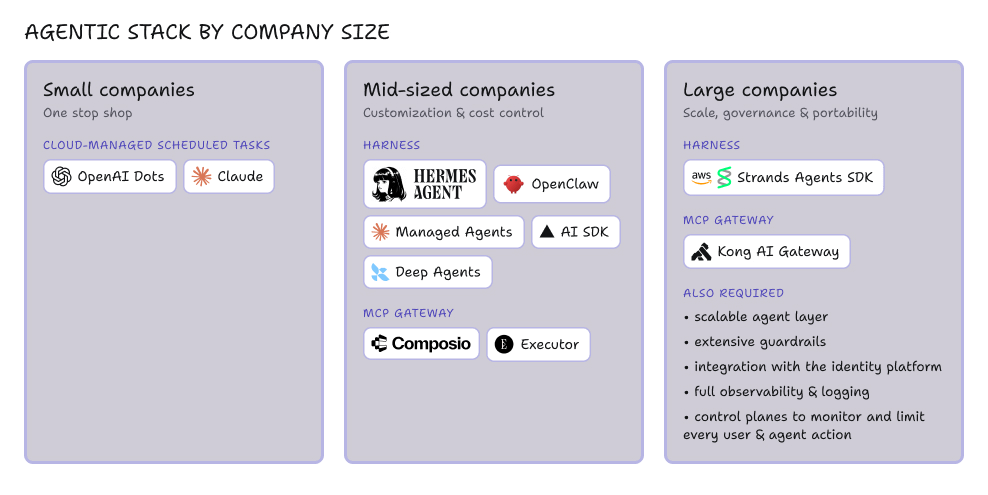
For small companies with limited technical resources, scheduled tasks managed in the cloud by OpenAI Dots or Anthropic’s Claude can work, provided that they are equipped with the necessary skills and are created under an independent identity with its own company and email accounts, rather than under each employee’s account.
At mid-sized companies, Hermes Agent shines thanks to its extensive customization options. It is well suited to running in the cloud. It supports open-weight models, reducing reliance on OpenAI and Anthropic’s pricing power. It should be combined with MCP gateways like Composio or Executor to set clear boundaries between the harness and credentials. Execution environments must also be clearly separated from the harness using short-lived sandboxes with filesystem, network, and resource limits.
Main alternatives include OpenClaw, Anthropic’s Managed Agents, as well as self-hosted frameworks like Vercel’s AI SDK and Langchain’s deep agents.
At large companies, the tech stack is more extensive. It requires a scalable agent layer, extensive guardrails, integration with the company’s identity platform, full observability and logging, and control planes to enable administrators to monitor and limit every user and agentic action.
Given how fast AI technology is evolving, the most important principle for enterprises is to stick to standard interfaces and formats and avoid proprietary approaches. AWS’s Strands SDK for the harness and Kong AI Gateway for the MCP gateway are examples of solutions that support standard formats (e.g., skills, MCP servers), whereas agents created in the Microsoft, Salesforce and Oracle platforms are harder to port to other ecosystems.
This blog post by Uber is a useful technical resource on how to leverage standardized formats and approaches to connect enterprise agents with enterprise systems via a central MCP gateway.